【富山県立高校入試・英語対策】長文読解
富山県立高校入試の英語では、まとまった英文を読み、内容一致・指示語説明・語句抜き出し・資料との照合を行う問題が出題されます。この記事では、本文の流れを追いながら必要な情報を整理する練習をします。
問題
A 英文を読んで答える問題
次の英文を読んで、問いに答えなさい。
Last month, our class talked about digital services in our town. Many people use smartphones to buy tickets, read news, and make appointments. These services are useful, but some people still have trouble using them.
One day, my grandmother wanted to buy a ticket for a local concert. The ticket was sold only on the Internet. She tried to use her phone, but she could not find the right button. She said, “I want to go to the concert, but I feel left behind.” I was surprised to hear that.
At school, we discussed how we could help people like her. Our teacher gave us these two ideas. First, we should make guide cards with large letters and simple pictures. Second, we should have a small support desk at the community center once a month. People can bring their phones and ask questions there.
I learned that technology is not useful for everyone in the same way. If we only make new services, some people may not be able to use them. We need to think about people who need help. When many people can use a service, the service becomes truly useful.
(1) 本文の内容に合うものを、ア〜エから1つ選びなさい。
- The writer’s grandmother could buy the concert ticket easily.
- The ticket for the concert was sold only on the Internet.
- The writer did not talk about digital services at school.
- The support desk will be open every day.
(2) 空欄に入る文として最も適切なものを、ア〜エから1つ選びなさい。
If we only make new services, ( ).
- some people may not be able to use them
- every student will stop using phones
- concerts will become free
- guide cards will disappear
(3) 下線部 these two ideas の内容を、日本語で2つ書きなさい。
(4) 「大きな文字と簡単な絵がある案内カード」という意味になるように、本文中から連続する8語を抜き出しなさい。
B 英文とメモを読んで答える問題
次の英文とメモを読んで、問いに答えなさい。
When I was in Australia, I ate lunch with my host family. Before eating, I said, “Itadakimasu.” My host brother asked me what it meant. I could not explain it well at first.
After that, I asked my Japanese teacher about it. She said that “Itadakimasu” shows thanks to many people and things. Farmers grow vegetables. Fishers catch fish. Families and cooks prepare meals. We also receive lives from plants and animals. So, the word is not only for the person who cooked the meal.
Then I thought about another word, “Gochisosama.” We usually say it after eating. It shows thanks for the meal and for the work behind it. These words are short, but they help us remember that food reaches us through many people and natural things.
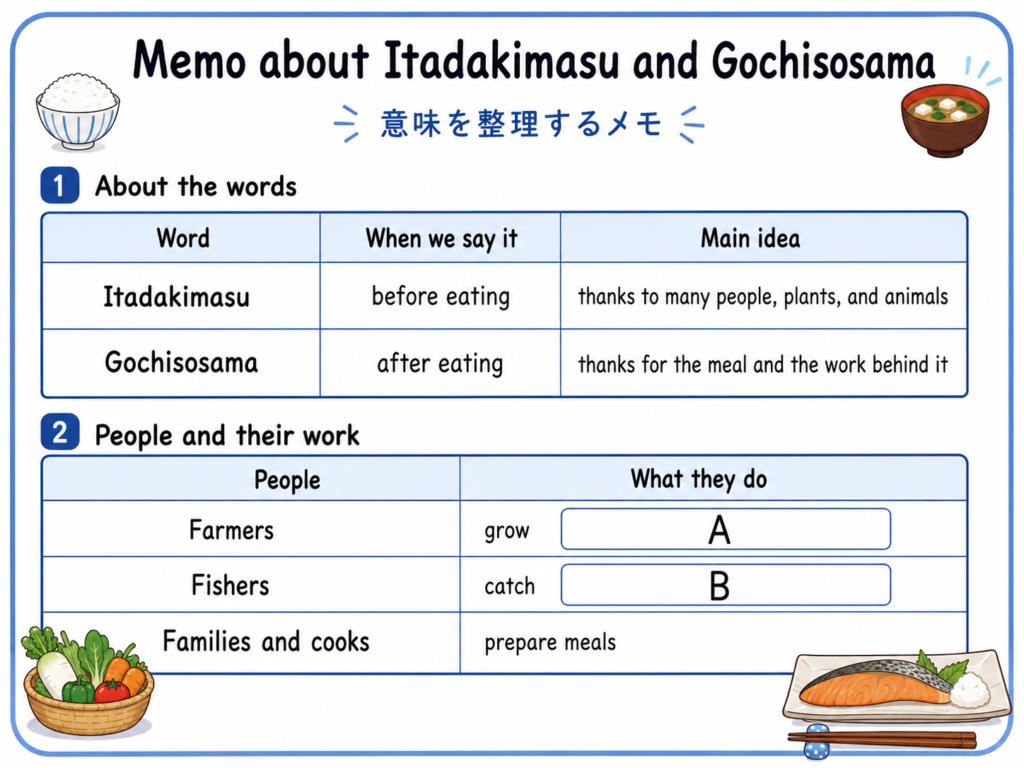
| Word | When we say it | Main idea |
|---|---|---|
| Itadakimasu | before eating | thanks to many people, plants, and animals |
| Gochisosama | after eating | thanks for the meal and the work behind it |
| People | What they do |
|---|---|
| Farmers | grow A |
| Fishers | catch B |
| Families and cooks | prepare meals |
(1) 本文の流れに合うものを、ア〜ウから1つ選びなさい。
- The writer could explain “Itadakimasu” perfectly at first.
- The host brother asked the writer about “Itadakimasu.”
- The writer learned the word from a book in Australia.
(2) 本文の内容に合うものを、ア〜ウから1つ選びなさい。
- “Itadakimasu” is only thanks to the person who cooked the meal.
- “Gochisosama” is usually said before eating.
- Both words help us remember many people and natural things.
(3) メモのAに入る1語を、本文中から抜き出しなさい。
A:Farmers grow ( ).
(4) メモのBに入る1語を、本文中から抜き出しなさい。
B:Fishers catch ( ).
(5) 本文を読んで、あなたが大切にしたい食事の習慣について、英語で10語以上書きなさい。
解答
- A:(1) イ (2) ア (3) ①大きな文字と簡単な絵がある案内カードを作ること。②月に1回、コミュニティセンターに相談窓口を設けること。 (4) guide cards with large letters and simple pictures
- B:(1) イ (2) ウ (3) vegetables (4) fish (5) 例 I want to say thank you before meals and eat without wasting food.
解説
Aの(1)は、本文第2段落に「チケットはインターネットだけで販売されていた」とあるためイです。アは、祖母が簡単に買えたという内容で本文と合いません。ウは、学校でデジタルサービスについて話し合ったという本文の内容と逆です。エは、相談窓口が毎日開くという内容ですが、本文では月に1回とされています。
Aの(2)は、本文最終段落の “If we only make new services, some people may not be able to use them.” という内容に合うためアです。新しいサービスを作るだけでは、それを使えない人が出るかもしれない、という流れを読み取ります。
Aの(3)は、下線部 these two ideas の直後にある First と Second に注目します。1つ目は、大きな文字と簡単な絵がある案内カードを作ることです。2つ目は、月に1回、コミュニティセンターに小さな相談窓口を設けることです。
Aの(4)は、「大きな文字と簡単な絵がある案内カード」にあたる本文中の表現を抜き出します。正解は guide cards with large letters and simple pictures です。guide / cards / with / large / letters / and / simple / pictures の8語です。
Bの(1)は、本文第1段落に “My host brother asked me what it meant.” とあるためイです。アは、筆者が最初からうまく説明できたという内容ですが、本文では “I could not explain it well at first.” とあります。ウは、本から学んだという内容で、本文とは合いません。
Bの(2)は、本文の最後に、これらの言葉が食べ物が多くの人や自然のものを通して自分たちに届いていることを思い出させてくれる、とあります。そのためウが正解です。
Bの(3)は、本文中の “Farmers grow vegetables.” から vegetables を抜き出します。
Bの(4)は、本文中の “Fishers catch fish.” から fish を抜き出します。
Bの(5)は、自分が大切にしたい食事の習慣について、英語で10語以上書きます。模範解答の “I want to say thank you before meals and eat without wasting food.” は12語で、条件を満たしています。
学習ポイント
- 指示語問題は、直後や直前の First / Second などの構造を確認する。
- 抜き出し問題は、語数をスペースごとに数える。
- 表やメモと本文を照合する問題では、表の空欄が本文のどの表現に対応しているかを探す。
- 英作文は、自分の意見と理由・具体例を短く自然につなげる。
※本記事は、過去問分析をもとに当塾が作成した学習用コンテンツです。出題傾向の分析・整理にはAIも活用しています。