【富山県立高校入試・英語対策】長文読解と資料の統合
今回は、富山県立高校入試の英語で見られる、まとまった英文を読み、本文の要点や具体的な内容を整理する問題を取り上げます。
文化に関する英文と、社会課題に関する英文の2つを読み、接続表現、内容説明、段落見出し、イラストとの対応、語句の抜き出しなどに取り組みます。
この記事では、実際の過去問をそのまま掲載するのではなく、過去数年分の出題傾向をもとに、当塾が独自に作成した予想問題・類題を紹介しています。
今回の予想問題
長文A Festival Sounds in a Changing Town
次の英文を読み、あとの問いに答えなさい。
[1] When Maya moved to a small town in Toyama, she was surprised by the summer festival. The streets were filled with people carrying lanterns, and a group of musicians played large drums. Maya had played the violin for years, but she had never touched a festival drum. At first, she thought the music was only for entertainment. Then an older resident, Mr. Kato, explained that each rhythm told people when to walk, stop, or lift the festival float. The sound was part of the town’s shared memory.
[2] The festival committee, ( A ), had a problem. Many young people had left the town, and fewer children were learning the traditional rhythms. Some members wanted to record the music and play it through speakers. Others believed that recorded sound would make the festival easier to continue, but Mr. Kato disagreed. He said that the important thing was not only the sound. Players watched one another, changed the strength of each beat, and responded to the people carrying the float.
[3] Maya suggested a workshop at the local school. Older players taught the basic rhythms, while students used tablet computers to record short interviews about the meaning of each song. The students then made simple guide cards with rhythm patterns and comments from the players. This did not replace face-to-face practice. Instead, it helped beginners review what they had learned and gave families a chance to talk about the festival at home.
[4] On the day of the festival, Maya joined the youngest drum team. She made one mistake, but the player next to her quickly changed his rhythm and helped the group continue. Maya finally understood Mr. Kato’s point. Tradition stays alive not because every performance is exactly the same, but because people listen, adjust, and pass their knowledge to others. The school project became a new way to share stories across generations.
〔注〕
lantern:ちょうちん festival float:祭りの山車 committee:委員会
rhythm:リズム record:録音する generation:世代
問1 空欄(A)に入る最も適切な語を、次のア~オから1つ選びなさい。
ア therefore イ however ウ for example エ also オ instead
問2 下線部Thisが指している内容を、日本語で具体的に書きなさい。
問3 本文の内容と合わないものを、次のア~エから1つ選びなさい。
- Mayaは町へ引っ越す前から、祭りの太鼓を演奏した経験があった。
- 祭りのリズムには、山車を運ぶ人々の動きを助ける役割があった。
- 加藤さんは、録音した音だけでは祭りの大切な部分を十分に残せないと考えていた。
- 学校の活動は、家庭で祭りについて話すきっかけにもなった。
次のア~エは、本文の段落[1]~[4]の見出しです。問4~問7では、各段落に最も適切なものを1つずつ選びなさい。
| ア | Technology Supporting Human Learning |
|---|---|
| イ | A First Look at the Meaning of Festival Music |
| ウ | Learning That Continues Through Cooperation |
| エ | A Tradition Facing a Difficult Future |
問4 段落[1]の見出しを選びなさい。
問5 段落[2]の見出しを選びなさい。
問6 段落[3]の見出しを選びなさい。
問7 段落[4]の見出しを選びなさい。
問8 「世代を超えて物語を共有する新しい方法」という意味になるように、本文中から連続する英語8語を抜き出しなさい。
長文B Vertical Farms and Local Food
次の英文を読み、あとの問いに答えなさい。
[1] Cities need fresh food, but bringing vegetables from distant farms uses time and energy. In some places, unused buildings are being changed into vertical farms. In these farms, plants grow on shelves placed one above another. LED lights are fixed above each shelf, and the roots receive water containing nutrients. Because the plants do not need soil, workers can keep the growing area clean and control the amount of water carefully.
[2] A group of students visited a vertical farm near their city. They expected to see a hot greenhouse, but the inside felt more like ( B ). Sensors checked temperature, light, and water every few minutes. When a sensor found a change, the system sent a message to a worker. This allowed the farm to use less water than many outdoor farms. It also made production more stable during heavy rain or very hot weather.
[3] However, vertical farming is not a perfect answer. The lights and air-control machines use electricity, and starting a farm can be expensive. The students learned that growing wheat or large fruit trees on shelves would not be practical. Leafy vegetables, herbs, and small strawberries are better choices because they grow quickly and do not need much space. The farm manager said, “We should use this method where its strengths are useful, not everywhere.”
[4] After the visit, the students discussed how their city could use the idea. One student suggested putting a small farm in an empty store near the station. Another proposed using electricity from solar panels on the roof. A third student wanted local restaurants to buy the vegetables, reducing the distance food traveled. Their teacher reminded them that a good plan must consider cost, energy, workers, and customers together.
[5] The class finally created a proposal for a small test farm. They did not claim that it would replace ordinary farms. Instead, they presented it as one part of a wider food system. Their main conclusion was that new technology becomes valuable when it solves a clear local problem and works together with existing methods.
〔注〕
vertical farm:垂直農場 nutrient:栄養分 sensor:センサー
production:生産 stable:安定した herb:香草
solar panel:太陽光パネル proposal:提案
問9 空欄(B)に入る最も適切なものを、次のア~ウから1つ選びなさい。
- a quiet laboratory
- a crowded outdoor market
- a traditional ric
 e field
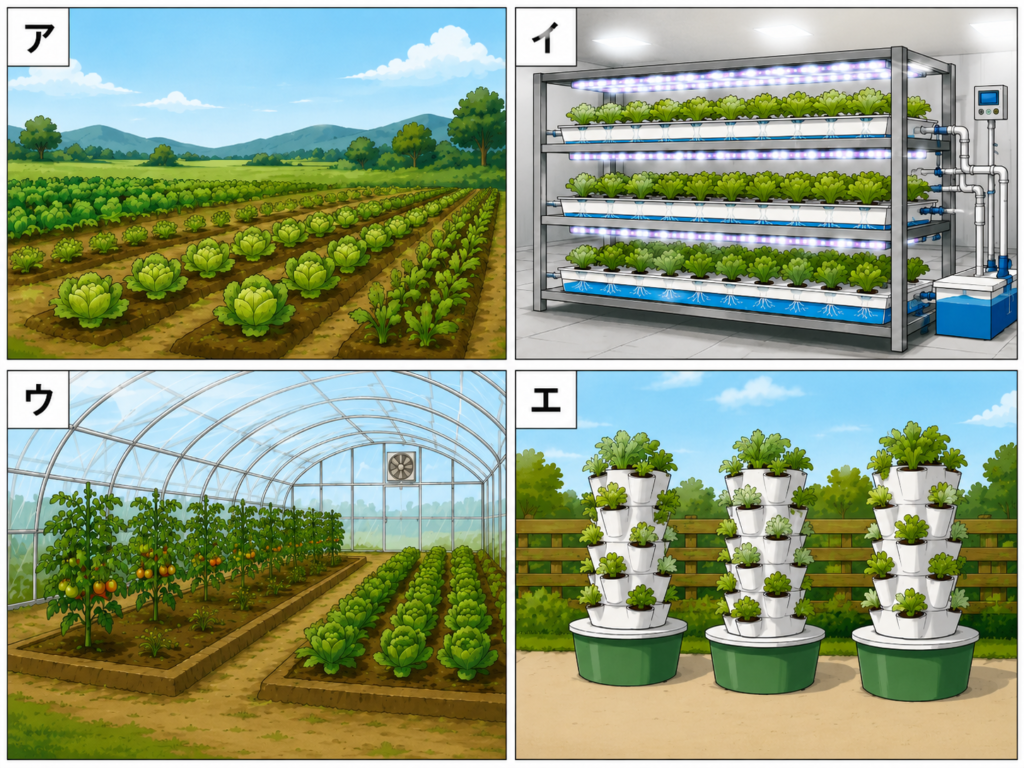
問10 次の4つのイラストは、異なる栽培方法を表しています。本文で説明されているvertical farmに最もよく合うものを、ア~エから1つ選びなさい。
問11 本文の内容に合うものを、次のア~エから1つ選びなさい。
- 垂直農場では、すべての種類の作物を屋外農場より安く育てられる。
- センサーは、温度や光、水の状態を定期的に確認していた。
- 農場の管理者は、普通の農場をすべて垂直農場に変えるべきだと考えていた。
- 生徒たちは、駅から遠い場所に大規模な小麦農場を造る計画を立てた。
問12 農場の管理者が最も伝えたかったこととして適切なものを、次のア~ウから1つ選びなさい。
- 新しい技術は、長所が生かせる場所を選んで使うことが大切である。
- 電気を使う農法は、費用に関係なくすぐに広げるべきである。
- 垂直農場では、大きな果樹を中心に育てるべきである。
問13 本文中のsensorsの役割として最も適切なものを、次のア~ウから1つ選びなさい。
- 野菜を駅まで自動的に運ぶこと
- 温度、光、水の変化を調べること
- レストランで野菜を販売すること
次の英文は、生徒たちの結論をまとめたものです。問14、問15では、空欄に入る英語を本文中からそれぞれ1語で抜き出しなさい。
New technology should solve a clear local ( C ) and work together with ( D ) methods.
問14 空欄(C)に入る1語を抜き出しなさい。
問15 空欄(D)に入る1語を抜き出しなさい。
正解
問1:イ
問2:生徒たちが、歌の意味についての短いインタビューを録音し、リズムの型や演奏者の話を載せた案内カードを作ったこと。
問3:ア
問4:イ
問5:エ
問6:ア
問7:ウ
問8:a new way to share stories across generations
問9:ア
問10:イ
問11:イ
問12:ア
問13:イ
問14:problem
問15:existing
解説
問1 接続語
段落[1]では祭りの音楽が持つ意味が説明されていますが、段落[2]では伝統を受け継ぐ人が減っているという問題へ話題が移ります。対照を表すhoweverが適切なので、正解はイです。
文中ではカンマにはさまれた副詞として使われており、The festival committee, however, had a problem.という自然な語順になります。
問2 指示語
Thisの直前には、生徒がインタビューを録音し、リズムの型や演奏者のコメントを載せた案内カードを作ったことが書かれています。
したがって、Thisはカードだけでなく、録音とカード作成を含む学校での活動全体を指しています。
問3 内容不一致
正解はアです。段落[1]には、Mayaは長年バイオリンを弾いていましたが、祭りの太鼓には一度も触れたことがなかったとあります。
イは、リズムが歩く、止まる、山車を持ち上げる時期を伝えていたことと一致します。
ウは、加藤さんが大切なのは録音された音だけではないと考えていたことと一致します。
エは、学校の活動が家庭で祭りについて話す機会を作ったことと一致します。
問4~問7 段落見出し
問4はイです。段落[1]では、Mayaが祭りの音楽を初めて見聞きし、その役割を知ります。
問5はエです。段落[2]では、若者や子どもの減少によって伝統の継続が難しくなっている状況が中心です。
問6はアです。段落[3]では、録音や案内カードという技術が、対面での練習を支えています。
問7はウです。段落[4]では、周囲と協力しながら知識を次の世代へ渡すことが中心です。
問8 連続する8語
段落[4]の最後にあるa new way to share stories across generationsを抜き出します。
a(1)/new(2)/way(3)/to(4)/share(5)/stories(6)/across(7)/generations(8)で、正確に8語です。
問9 文脈に合う表現
生徒たちは暑い温室を予想していましたが、その後にはセンサーが温度、光、水を確認する設備が説明されています。
研究設備のある静かな場所を表すa quiet laboratoryが最も自然なので、正解はアです。
問10 本文とイラストの対応
正解はイです。本文では、植物が上下に重ねた棚で育ち、各棚の上にLEDライトがあり、根には栄養分を含む水が与えられると説明されています。
アは屋外の畑、ウは土を使う一般的な温室、エは屋外の縦型プランターであるため、本文の条件をすべて満たしません。
イだけが、屋内、多段の棚、LEDライト、養液、土を使わないという条件に一致します。
問11 内容一致
正解はイです。段落[2]に、センサーが数分ごとに温度、光、水を確認していたとあります。
アは、費用が高く、すべての作物に適しているわけではないため誤りです。
ウは、管理者が垂直農法をどこでも使うべきではないと述べているため誤りです。
エは、生徒たちが駅の近くに小規模な試験農場を作る案をまとめたことと反対です。
問12 発言の主旨
正解はアです。農場の管理者は、垂直農法をあらゆる場所で使うのではなく、その長所が役立つ場所で使うべきだと述べています。
費用を考えずに広げることや、大きな果樹を中心に育てることは、本文の内容と反対です。
問13 センサーの役割
正解はイです。段落[2]には、Sensors checked temperature, light, and water every few minutes.とあります。
センサーは野菜を運んだり販売したりするものではなく、栽培環境の変化を調べるために使われています。
問14・問15 要約文の空欄
段落[5]の最後に、new technology becomes valuable when it solves a clear local problem and works together with existing methodsとあります。
したがって、問14はproblem、問15はexistingです。どちらも本文中から1語ずつ抜き出します。
この問題で身につけたいポイント
- 接続語の前後を読み、内容が追加・対立・結果のどれに当たるかを判断する。
- 段落見出しでは、具体例だけでなく、段落全体に共通する中心内容を捉える。
- 図や要約文がある問題では、本文中の設備、動作、条件、評価を一つずつ対応させる。
まとめ
長文読解では、英文を最初から最後まで日本語に訳すだけでなく、段落ごとの役割や、人物の考えが変化する流れを整理することが大切です。接続語や指示語は、その流れを確認する手がかりになります。
また、イラストや要約文と組み合わせた問題では、本文中の一部分だけで判断せず、設備の配置、使うもの、目的、課題など複数の条件を照合しましょう。普段の練習でも、答えの根拠となる英文を本文中で確認する習慣をつけておくことが重要です。
※本記事は、過去問分析をもとに当塾が作成した学習用コンテンツです。出題傾向の分析・整理にはAIも活用しています。